


TL;DR: A randomised, placebo-controlled trial found men taking oral pumpkin seed oil for 24 weeks saw a 40% increase in hair count, compared to 10% with placebo. A separate 2022 review looked at how pumpkin seed might work when applied topically. Both are promising, both come with caveats — here's the honest breakdown, plus a gentle daily habit that brings pumpkin seed to your scalp.
Pumpkin seed oil has quietly become one of the more interesting ingredients in scalp care — and unlike most wellness trends, it actually has peer-reviewed research behind it. The catch: some of that research involves swallowing capsules, not applying oil to the scalp. Here's what the studies say, and what's reasonable to expect.
This article is general information, not medical advice. For persistent, sudden, or patchy hair loss, please see a doctor or dermatologist.
Get the Same Botanical, Minus the Capsules
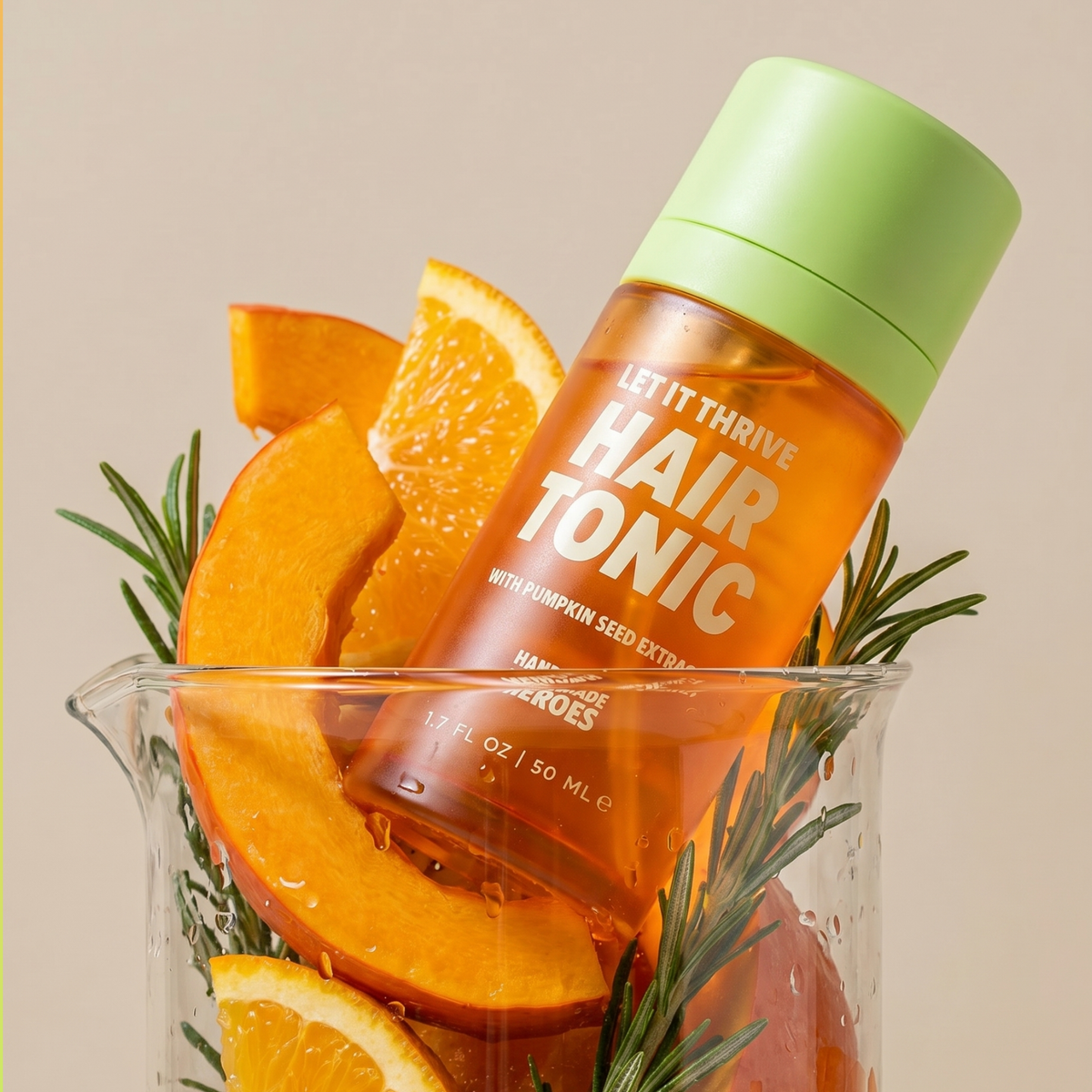
You don't need to swallow a supplement for six months straight to bring pumpkin seed into your routine — just ten seconds and a light hand each day. Let It Thrive Hair Tonic is built on that same pumpkin seed, alongside rosemary, in a natural, vegan, cruelty-free formula with no prostaglandins and no biotin. It conditions the scalp and supports a healthy-looking scalp and the appearance of fuller, thicker-looking hair. One spray, a 30-second scalp massage, done. Shop Let It Thrive Hair Tonic or browse the full hair care collection.
The Key Study (Cho et al., 2014)
The most-cited study is a randomised, double-blind, placebo-controlled trial published in Evidence-Based Complementary and Alternative Medicine. Seventy-six men with pattern hair loss (androgenetic alopecia) took either 400mg of pumpkin seed oil or a placebo capsule daily for 24 weeks. The pumpkin seed oil group showed a mean increase of 40% in hair count, compared to 10% in the placebo group — a statistically significant difference, with no significant side effects reported.
A few caveats worth holding onto: this was an oral supplementation study, not a topical one. It was conducted in men with pattern hair loss specifically, so results may not generalise to women or to everyday shedding. And it's a single trial — helpful, but not the final word.
What About Applying It to the Scalp?
A 2022 review in Pharmaceuticals examined plant-based oils used topically in hair and scalp care. Pumpkin seed oil was highlighted for its phytosterol content — particularly delta-7-sterols — thought to interact with the same 5-alpha-reductase pathway some clinical treatments target. The review noted that topical evidence remains more limited than the oral evidence, with further clinical investigation still needed. In other words: the mechanism is plausible and the oral data is encouraging, but topical-specific trials are still catching up — which is exactly why we chose pumpkin seed as an ingredient, not a promise that a topical tonic will match the oral study's numbers.
Why the Mechanism Makes Sense
Pumpkin seed oil brings a well-rounded profile to scalp care: phytosterols and delta-7-sterols that may interact with the DHT pathway at the follicle, zinc, which is linked to healthy follicle function in nutritional literature, and fatty acids like linoleic and oleic acid, which help moisturise and condition both the scalp and hair fibre. None of this makes it a treatment — Let It Thrive Hair Tonic is a cosmetic conditioning product, not a drug — but it does make pumpkin seed a genuinely well-rounded conditioning ingredient.
Is pumpkin seed oil better as a supplement or applied to the scalp?
The strongest clinical evidence (Cho 2014) is for oral supplementation, taken under guidance from a healthcare provider. Topical evidence is growing but less established — many people use both, but supplements should always be discussed with a doctor first.
How long before I'd see a difference?
The Cho 2014 study ran for 24 weeks. Hair cycles are slow, so give any topical routine at least a few months of consistent use before judging results.
Does pumpkin seed oil work for women too?
The primary trial was conducted in men. There's no obvious mechanistic reason it couldn't be relevant for women, but that population hasn't been studied in the same way — more research is needed.
Sources
Cho YH, et al. Oral pumpkin seed oil and hair count in men with pattern hair loss: a randomized, double-blind, placebo-controlled trial. Evid Based Complement Alternat Med. 2014. pmc.ncbi.nlm.nih.gov/articles/PMC4017725
Plant-based oils in topical hair and scalp care: a review. Pharmaceuticals. 2022. mdpi.com/1424-8247/15/8/930
Real ingredients. Real results.


Leave a comment
All comments are moderated before being published.
This site is protected by hCaptcha and the hCaptcha Privacy Policy and Terms of Service apply.