


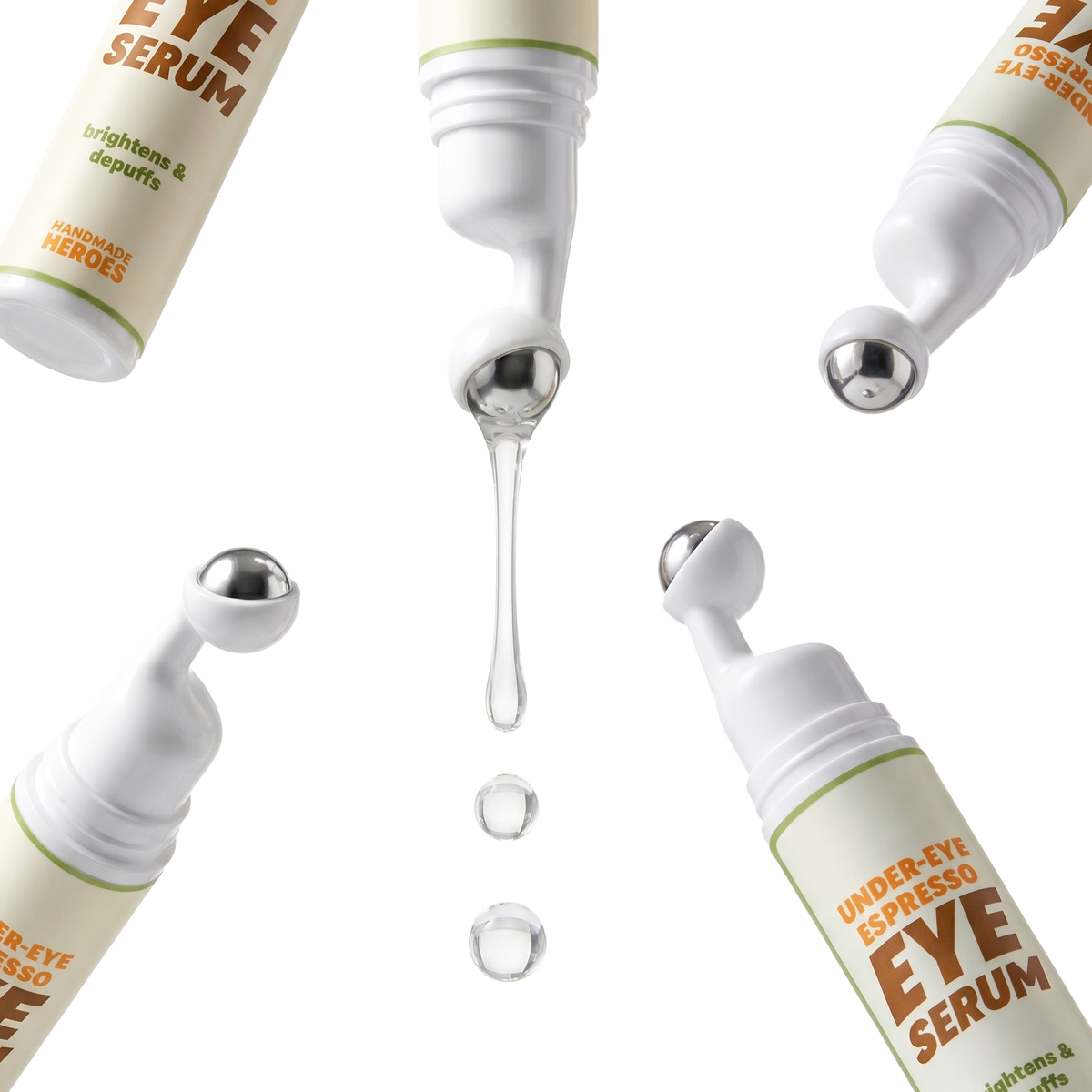
TL;DR: Under Eye-Espresso Eyebag Serum has fifteen ingredients, and every one has a job. Here's the full INCI list, grouped by role — actives, humectants, preservative system and pH balancers — so you know exactly what's in the bottle and why.
The whole ingredient list, no secrets
Full INCI: Aqua, Pentylene Glycol, Propanediol, Cyclodextrin, Caffeine, Epigallocatechin Gallatyl Glucoside, Sodium Ascorbyl Phosphate, Sodium Hyaluronate, Butylene Glycol, Sodium Benzoate, Citrus Reticulata (Tangerine) Fruit Extract, Benzoic Acid, Sodium Phytate, Sodium Bicarbonate, Citric Acid.
That's it — fifteen ingredients, listed in the order the formula uses them, heaviest to lightest. No filler, no vague "proprietary blend" hiding what's actually in the bottle. Here's what each one is doing.
The actives — what's doing the work
Caffeine is the hero. It's included for its well-documented ability to increase microcirculation in skin, which is the mechanism behind its cosmetic use for the look of puffiness and under-eye darkness.1 More on that in does caffeine work for dark circles and eye bags?
Epigallocatechin Gallatyl Glucoside is a stabilised, glucoside-bound form of EGCG, green tea's most-studied polyphenol antioxidant.2 The glucoside bond keeps it shelf-stable instead of oxidising before it reaches your skin — the full story is in what is EGCG?
Sodium Ascorbyl Phosphate is a stable, gentle vitamin C derivative.3 It brightens the look of the under-eye and contributes antioxidant defence, without the instability — or the sting — that raw L-ascorbic acid can bring to thin eye skin.
Sodium Hyaluronate is the salt form of hyaluronic acid — a humectant that draws in and holds onto water, hydrating skin and supporting the appearance of plumper, smoother-looking fine lines.4
Citrus Reticulata (Tangerine) Fruit Extract is a naturally derived botanical, included for its antioxidant and brightening properties.
Cyclodextrin isn't an active on its own — it's a delivery ingredient, a ring-shaped sugar molecule that helps stabilise and carry the other actives through the formula.
The supporting cast
Pentylene Glycol, Propanediol and Butylene Glycol are humectants — they help pull in moisture and keep the texture light rather than greasy, so it layers well under whatever you moisturise with next.
Sodium Benzoate and Benzoic Acid are the preservative system. We're not going to call this serum "preservative-free" — that's not really an option for a water-based formula, and it's not a claim we'd want to make anyway. There are good synthetic ingredients and bad ones, and the difference is what the research says, not what the marketing says. This is a well-studied, low-irritancy preservative pairing doing an unglamorous but essential job: keeping the formula safe to use.
Sodium Phytate is a chelator — it binds trace metal ions that can otherwise destabilise a formula over time.
Sodium Bicarbonate and Citric Acid balance the pH of the formula, which matters for both stability and comfort on skin as sensitive as the eye area.
Aqua is water — the base the rest of the formula is built on.
Try it
Every ingredient above is in Under Eye-Espresso Eyebag Serum for a reason, and none of them are hiding behind a "fragrance" or "blend" label. It's a lightweight, water-based eye serum, vegan and cruelty-free, formulated with cited actives rather than trend ingredients. Shop Under Eye-Espresso Eyebag Serum and see the whole formula for yourself.
FAQ
Is this serum "all-natural"?
No, and we wouldn't claim it. It combines naturally derived actives — tangerine extract, the EGCG derivative — with well-studied synthetic ingredients like the preservative system. Both categories earn their place through what the research shows, not through a marketing label.
Is it vegan and cruelty-free?
Yes, on both counts.
Related reading
Sources
Herman A, Herman AP. "Caffeine's Mechanisms of Action and Its Cosmetic Use." Skin Pharmacology and Physiology. 2012;26(1):8-14. doi.org/10.1159/000343174
Kim E, Hwang K, Lee J, et al. "Skin Protective Effect of Epigallocatechin Gallate." International Journal of Molecular Sciences. 2018;19(1):173. ncbi.nlm.nih.gov/pmc/articles/PMC5796122
Boo YC. "Ascorbic Acid (Vitamin C) as a Cosmeceutical to Increase Dermal Collagen for Skin Antiaging Purposes: Emerging Combination Therapies." Antioxidants. 2022;11(9):1663. ncbi.nlm.nih.gov/pmc/articles/PMC9495646
Robinson DM, Vega J, Palm MD, et al. "Multicenter evaluation of a topical hyaluronic acid serum." Journal of Cosmetic Dermatology. 2022;21(9):3848-3858. pubmed.ncbi.nlm.nih.gov/35833366
Real ingredients. Real results.


Leave a comment
All comments are moderated before being published.
This site is protected by hCaptcha and the hCaptcha Privacy Policy and Terms of Service apply.